
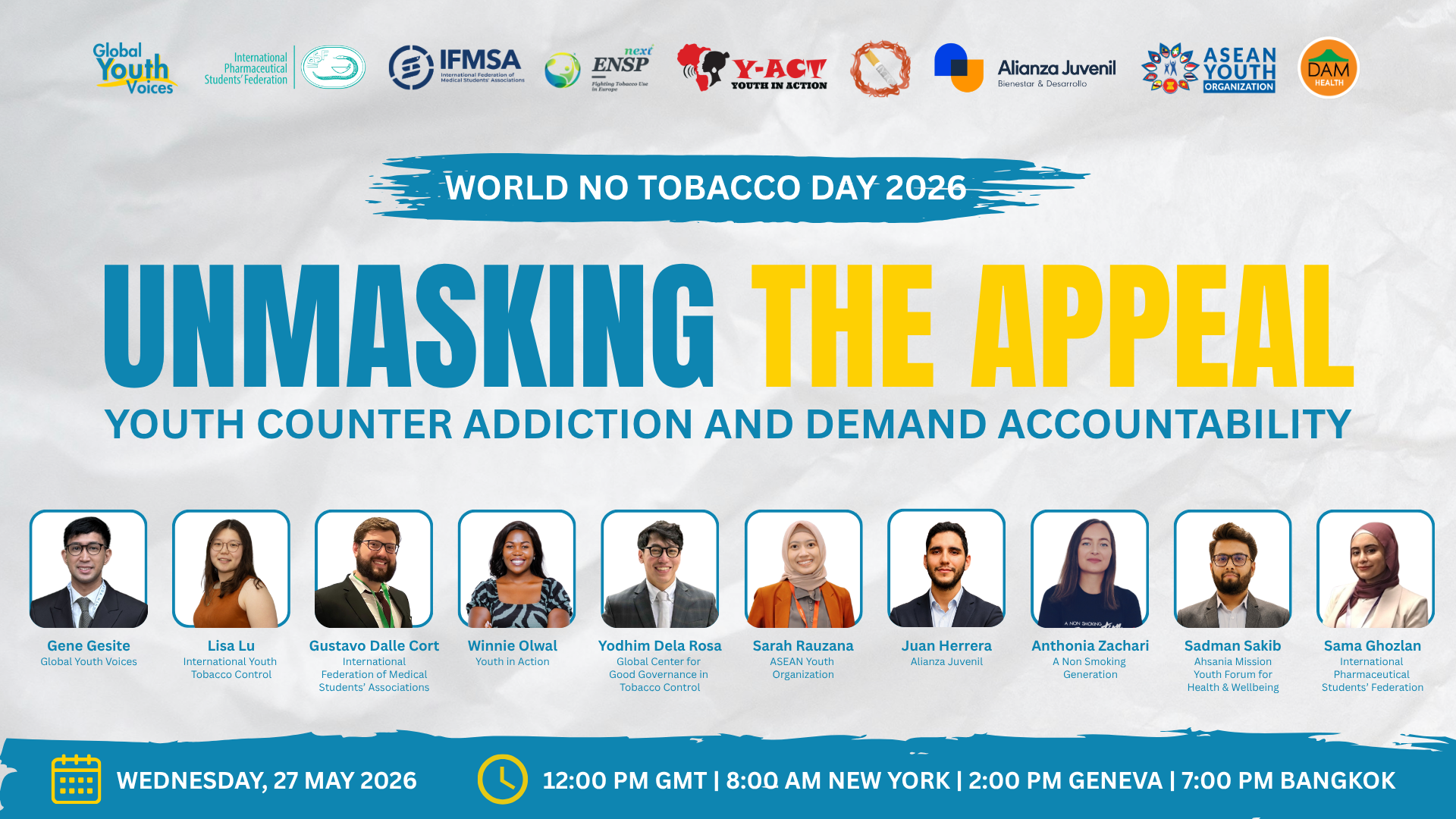
On 27 May 2026, Global Youth Voices (GYV) Movement, together with its participating organizations, including the International Youth Tobacco Control (IYTC), the International Pharmaceutical Students’ Federation (IPSF), the International Federation of Medical Students’ Associations (IFMSA), ASEAN Youth Organization (AYO), Youth in Action (Y-ACT), Alianza Juvenil, A Non Smoking Generation, and Ahsania Mission Youth Forum for Health & Wellbeing, convened a webinar for World No Tobacco Day 2026 entitled:
“Unmasking the Appeal: Youth Counter Addiction and Demand Accountability.”
The discussion focused on a question young people around the world are increasingly asking: if governments know how the tobacco and nicotine industry attracts young people, why are these products still being allowed to reach us?
Speakers from different regions described different products, different markets, and different realities. Yet the story was remarkably similar. Products are designed to attract young people. Marketing adapts to new platforms and trends. Industry influence weakens protections. Young people are left to deal with the consequences.
Addiction Doesn’t Happen by Accident
Opening the webinar, Gene Gesite, Coordinator of Global Youth Voices, reflected on what he has witnessed as a basketball coach working with young people.
Nicotine products are no longer appearing in the familiar form of cigarettes sold behind store counters. Today they come in sleek devices, sweet flavors, attractive packaging, and social media content designed to blend seamlessly into youth culture. Gene stressed that this shift is not accidental. Products are being engineered to appear modern, discreet, and harmless while serving the same purpose they always have: creating and sustaining addiction.
He reiterated the demands of the Global Youth Voices Declaration: eliminate product appeal, ban harmful nicotine products, protect policymaking from tobacco industry interference, and hold the tobacco industry accountable for the harms it causes.
Speaking on behalf of the ASEAN Youth Organization (AYO), a regional youth network spanning Southeast Asia and recognized by the ASEAN Secretariat, Sarah Rauzana challenged the idea that youth nicotine use is simply a matter of individual choice. She argued that young people are increasingly being treated as “replacement consumers” by an industry seeking new users to replace those lost to disease, death, and cessation.
Drawing from developments in Indonesia, Sarah highlighted how flavors, influencer marketing, and digital promotion continue to attract young people while reducing perceptions of harm. She also raised concerns about reports of dangerous psychoactive substances being detected in vape liquids and noted that Indonesia’s National Narcotics Agency has encouraged a total prohibition of electronic cigarettes following these findings. Her intervention challenged the narrative that these products represent innovation and instead framed them as part of a broader strategy to expand addiction among young people.
From Sweden, Anthonia Zachari of A Non Smoking Generation highlighted the rapid growth of nicotine pouches and oral nicotine products among young people. Products marketed as “tobacco-free” continue to deliver addictive nicotine while exploiting regulatory loopholes and avoiding restrictions that apply to traditional tobacco products. Her intervention underscored how the industry continuously adapts its products to remain attractive, accessible, and socially acceptable to young people. Rather than allowing these products to become normalized, she argued that governments should act before another generation becomes addicted.
For Sama Ghozlan, whose organization, the International Pharmaceutical Students’ Federation (IPSF), represents approximately 600,000 pharmacy students and recent graduates worldwide, the issue was straightforward. Nicotine remains addictive regardless of the product delivering it. She challenged the growing normalization of nicotine use among young people and argued that no level of youth addiction should be accepted as inevitable. As new products continue to emerge, she stressed the importance of keeping public health at the center of policy discussions.
Taken together, these interventions painted a clear picture. Today’s products may look different, but the strategy remains the same: make addiction attractive, make it appear harmless, and recruit the next generation.
The Industry Doesn’t Just Sell Products. It Sells Influence.
The discussion then turned to a question often left out of conversations about youth addiction: why do harmful products continue to reach young people despite growing evidence of harm?
Drawing on the Global Center for Good Governance in Tobacco Control’s work tracking tobacco industry interference worldwide, Yodhim Dela Rosa argued that the answer cannot be separated from the influence of the tobacco industry itself. He described how companies increasingly present themselves through the language of innovation, harm reduction, sustainability, and partnership while continuing to oppose measures that would reduce nicotine addiction.
Behind those narratives, he noted, are familiar tactics: lobbying, front groups, political pressure, and efforts to weaken public health protections. Yodhim emphasized that no country has been spared from tobacco industry interference and highlighted the Global Tobacco Industry Interference Index as a critical tool for exposing these practices and strengthening implementation of WHO FCTC Article 5.3.
Bringing a perspective from Bangladesh, Sadman Sakib of the Ahsania Mission Youth Forum for Health and Wellbeing pointed to examples showing how industry influence can weaken or delay public health measures. His intervention reinforced a message heard repeatedly throughout the webinar: the tobacco industry is not a stakeholder in public health policy and should not be involved in shaping regulations intended to protect people from its products.
The discussion made clear that addiction is not sustained by marketing alone. It is also sustained by an environment where industry influence continues to shape policy decisions.
Young People Are Demanding More Than Awareness
Several speakers stressed that awareness campaigns alone will not solve the problem.
Across many African countries, there is still an opportunity to prevent another generation from becoming addicted to nicotine products, said Winnie Olwal of Youth in Action (Y-ACT), one of Africa’s leading youth-led advocacy movements with networks across the region. Rather than repeating mistakes seen elsewhere, she urged governments to act before emerging nicotine products become deeply embedded in youth culture. Prevention, she argued, is always easier than reversing an addiction epidemic once it has taken hold.
Speaking from the perspective of Alianza Juvenil, a youth coalition connecting advocates across Latin America, Juan Camilo Herrera Palacio emphasized that young people are not waiting to inherit the consequences of today’s decisions. Across the region, youth advocates are organizing to challenge industry influence, promote stronger public health protections, and ensure that policymaking reflects the interests of future generations rather than commercial interests.
Gustavo H.N. Dalle Cort of the International Federation of Medical Students’ Associations (IFMSA), a federation representing more than 1.5 million medical students across over 120 countries, focused on the enormous burden created by tobacco and nicotine products. He highlighted the health, social, economic, and environmental costs that continue to be borne by families, communities, and governments while companies profit from addiction.
His message was straightforward: the tobacco industry should pay for the harms it causes. That includes liability measures addressing addiction, disease, environmental damage, and the deliberate targeting of young people.
Together, these interventions moved the conversation beyond awareness and toward accountability.
The Call Was Clear: Ban It
One of the most powerful moments of the webinar was the launch of the Ban It campaign video.
The video did not call for better marketing standards, stronger warning labels, or more awareness campaigns. It called for action.
Its message reflected a concern raised throughout the discussion: products designed to attract, addict, and recruit young people should not be normalized, accommodated, or repackaged as solutions. They should be banned.
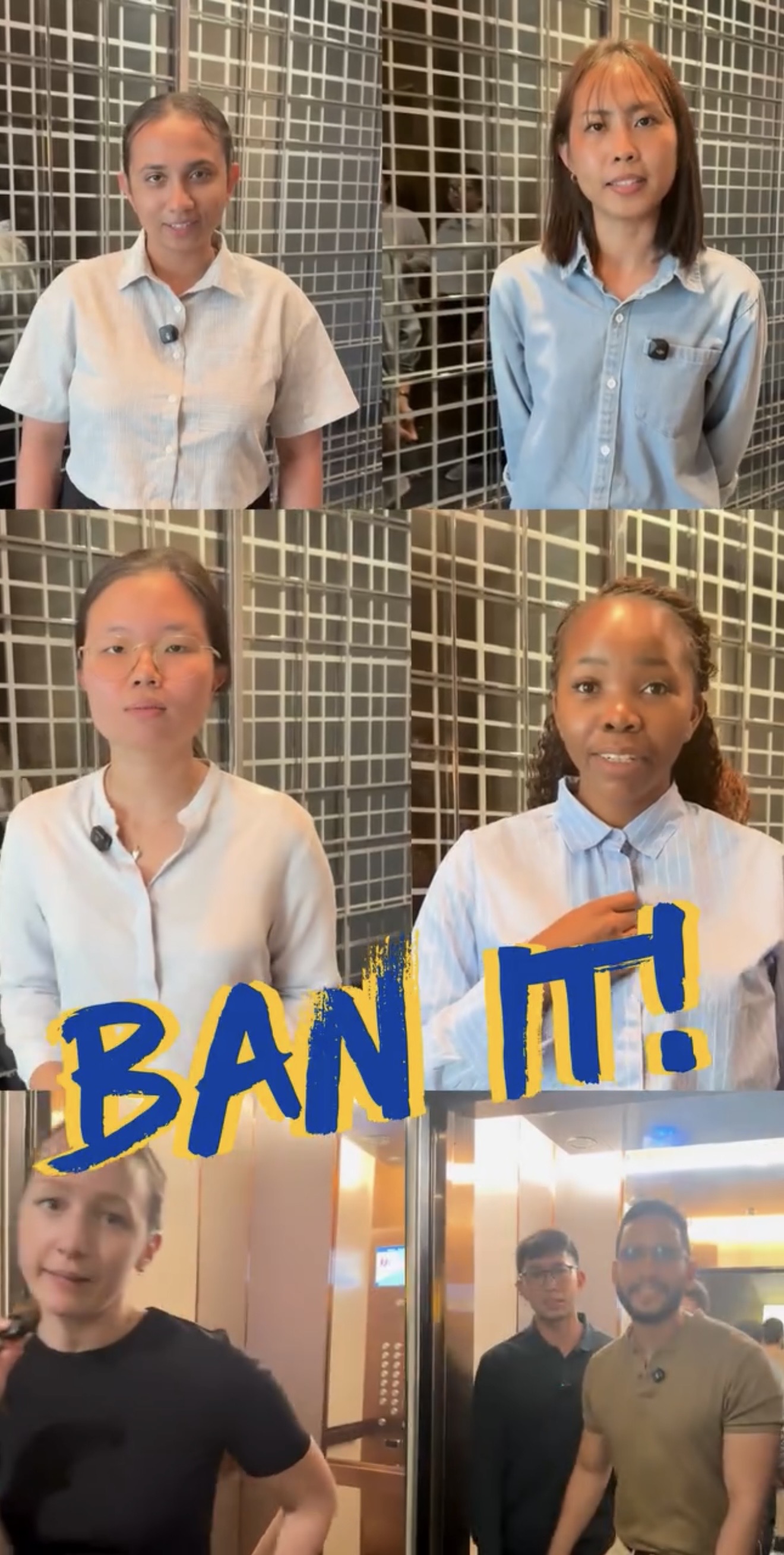
Its message reflected a concern raised throughout the discussion: products designed to attract, addict, and recruit young people should not be normalized, accommodated, or repackaged as solutions. They should be banned.
The launch captured the direction of the broader conversation. Whether speakers were discussing flavored vapes in Southeast Asia, nicotine pouches in Sweden, policy interference in Bangladesh, prevention efforts across Africa, or accountability measures championed by global student networks, they returned to the same concern: young people continue to be exposed to products intentionally designed to create addiction.
The video transformed that concern into a collective demand. Protecting future generations requires more than warning young people about addiction after the fact. It requires removing the products, practices, and industry tactics that drive addiction in the first place.
The call to ban harmful nicotine products sat alongside the other demands raised throughout the webinar: eliminate product appeal, protect policymaking from tobacco industry interference, and hold the tobacco industry accountable for the harms it causes.
A Global Youth Call for Action
In her closing remarks, Lisa Lu of International Youth Tobacco Control (IYTC), a youth-led network active across 60 countries, connected the experiences shared throughout the webinar.
From Southeast Asia to Europe, Africa, and Latin America, speakers described different products but the same problem: an industry that continues to reinvent addiction while avoiding accountability.
Young people are no longer asking governments to study the issue. They are asking governments to act.
The demands were clear:
Ban all tobacco and nicotine products.
Protect public policy from tobacco industry interference.
Hold the tobacco industry financially and legally accountable for the harms it causes.
Protecting future generations requires more than warning young people about addiction.
It requires confronting the industry that profits from it.